126
"Furnace city" emerges as "coolcation" magnet for global travelers_我的网站

一 |
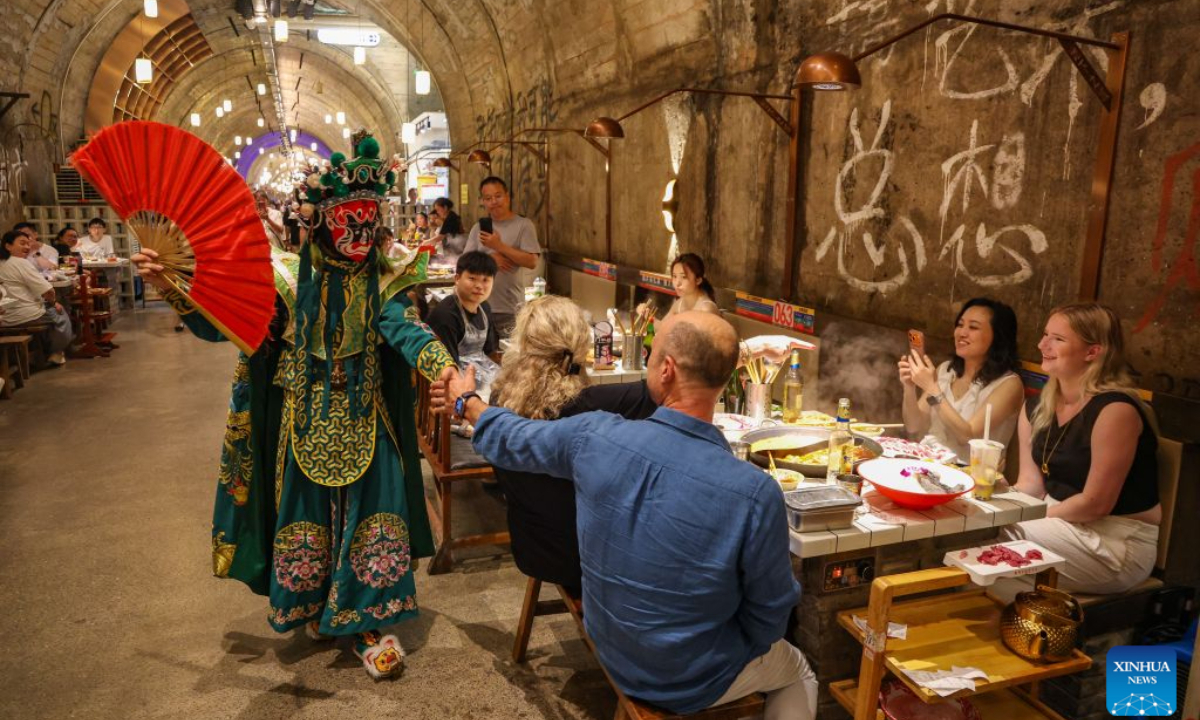
Foreign tourists enjoy hotpot while watching a Sichuan Opera face-changing performance inside a former air-raid shelter at the Underground City hotpot restaurant in Liangjiang New Area of southwest China's Chongqing Municipality, July 10, 2026. (Xinhua/Huang Wei)Despite outdoor temperatures nearing 40 degrees Celsius in southwest China's Chongqing Municipality, Australian tourist Roy Rostand was enjoying hotpot at a restaurant without air conditioning, apparently feeling no discomfort from the summer heat.
The answer to his comfort lies in the restaurant's unlikely location. This hotpot restaurant, named Underground City, is hidden inside a former air-raid shelter, one of the city's distinctive spaces offering natural coolness.
"It's amazing that the restaurant stays so cool even in scorching summer heat," Rostand said. "Chongqing has given me the chance to experience something I can't find in Australia."
Chongqing has long been dubbed one of China's "furnace cities" for its sweltering, humid summers. In July alone, the city endured 26 consecutive days of high heat, with temperatures breaching 40 degrees Celsius for a full week and topping out at a scorching 41.6 degrees.
The blazing heat, however, has failed to dampen the enthusiasm of global travelers. According to the Chongqing General Station of Exit and Entry Frontier Inspection, more than 610,000 inbound and outbound trips by foreign nationals were recorded at Chongqing Jiangbei International Airport in the first half of the year, marking an 86-percent surge year on year. The top five source countries were Thailand, Malaysia, Singapore, Vietnam and Indonesia.
European travelers proved to be a standout growth driver. Data from Trip.com shows that as of July 21, inbound travel bookings from Europe to Chongqing for this summer season climbed by over 40 percent year on year, while scenic spot ticket orders surged by 214.7 percent and activity-based bookings rocketed by a staggering 6,900 percent.
Thanks to China's visa-free policies and other travel facilitation measures, Chongqing is rapidly gaining traction as a go-to "coolcation" hotspot for international visitors. Creative cool-off spaces, diverse travel experiences and comprehensive summer services have all contributed to its rising appeal.
UNDERGROUND COOL
Chongqing's summer cooling secrets were first found underground. Since the late 1930s, the city has carved thousands of air-raid shelters into its mountainous terrain.
Once serving as sanctuaries for civilians during the Chinese People's War of Resistance against Japanese Aggression, these spaces have now been repurposed as hotpot restaurants, tea houses and venues for Sichuan Opera performances, providing both refreshing coolness and preserving the city's living memories.
"The temperature inside the shelters remains around 25 degrees Celsius all year round, making them natural cool retreats," explained Wang Jing, marketing director of Underground City.
"We serve more than 300 tables a day on weekends," she added. "Right now, about one in every six diners is from overseas. And we're seeing more and more visitors from Southeast Asia and Europe."
Annika, a tourist from Germany, revealed that the restaurant has gone viral on overseas social media platforms. "We were attracted not only by this unique way of escaping the summer heat, but also by the opportunity to dine in a place filled with history and culture," she said.
CHASING CHILL
On August 1, Chongqing issued an orange heat alert. At a water park in its Fuling District, 10 tonnes of industrial ice were dumped directly into the wave pool. Half-submerged in the refreshing water, visitors could splash around or even play mahjong at custom-made tables in the pool.
This unique summer cooling scene has attracted coverage from mainstream media in countries including Russia and Canada, with overseas outlets reportedly dubbing it the most intriguing summer spectacle in China this year.
At Chongqing Xingrui international travel service, inquiries from cross-border travelers hailing from hot and humid regions such as Vietnam, Laos and Indonesia have risen notably in recent weeks.
Peng Hengcong, head of the travel agency, said they have rolled out themed tour products, including "cool retreats in the mountains" and "gorge rapids adventures," tailored to overseas visitors seeking summer cooling experiences. These products cover areas with higher altitudes or rich water systems in Chongqing, with the highlight being a "23°C summer" experience.
Luo Zibai, an expert with the China Tourism Academy, believes that Chongqing's sustained popularity among travelers lies in its ability to fully leverage its distinctive strengths and develop differentiated tourism products that offer a broad spectrum of experiences.
URBAN REFUGE
Chongqing is weaving a citywide "cooling network" -- ranging from shopping malls to public facilities, and from indoor spaces to outdoor areas.
At a shopping mall called The Ring in the city, visitors are greeted not by endless rows of shops, but by a lush indoor rainforest. With misting systems and carefully designed lighting, the mall keeps the temperature at about 21 degrees Celsius, creating a cool, dreamy summer escape.
"I like Chongqing a lot because it has its own character," said Bilal Badri, who was visiting from the Netherlands. "The way nature and the city's landscape blend together here is just perfect."
The cool experience extends beyond the mall. In the Mountain City Alley historic district, a 400-meter-long pedestrian walkway has been transformed into a "cooling corridor," where misting systems and shaded areas reduce the perceived temperature by 3 to 5 degrees Celsius.
In addition, since July 8, Chongqing's rail transit system has set up cooling zones in 158 metro stations, offering free air-conditioned spaces and heat-relief supplies to residents and tourists alike.
"Chongqing's creative and thoughtful ways to help people beat the summer heat are impressive. It's really interesting to discover these unique experiences," said Alexandra, a Romanian tourist. "This time I didn't stay long enough to explore more of the city, and I'm planning to come back in the near future."
。 海峡网讯(记者 李牧晨)8月21日,福建省人工智能创新发展交流活动在福州举行。活动现场发布三大产业发展举措:福建省智能体创新联合体计划、福建省人工智能众测行动、“模数未来”人工智能生态合作伙伴计划,三者分别聚焦技术落地攻坚、产品质量验证、产业生态支撑,形成全链条协同体系。 智能体创新联合体:破解落地痛点
该联合体采用“技术研发+场景应用+标准机构”三位一体模式,聚焦工业设备运维、质量管控、能源管理、海洋水产养殖、农业茶园种植等细分领域,首批已组建6组,推动智能体从“单点试用”向规模化、规范化、标准化升级。 众测行动:筑牢安全底线
依托福建省人工智能与软件质量中试服务平台,联合中国信通院、中国软件评测中心、国家工业信息安全发展研究中心等机构,整合“智钺”“智体通鉴”“智规”三大平台技术力量,围绕模型和智能体的功能、性能、安全等维度开展测评。首期聚焦人工智能安全,覆盖内容安全、指令安全等方向。 生态合作伙伴计划:构建产业协作网络
由福建省工业信息产业发展研究中心牵头,联合运营商、高校、科研院所、龙头企业等12家单位发起,已汇聚国内50家头部单位。计划围绕技术协同攻关、标准联合制定、数智人才共育、安全治理协作、产业发展共创五大方向,打造开放共享的福建特色人工智能产业生态。
Current article:http://www.bainangmieruopanglaomen.sbs/prwign/uiokjf.html
Published on:15:57:11


