七侠五义
Xi holds talks with Jordan's king; visit empowers development co-op to serve as a pillar of regional stability: expert_我的网站

A | 今天,7月21号。
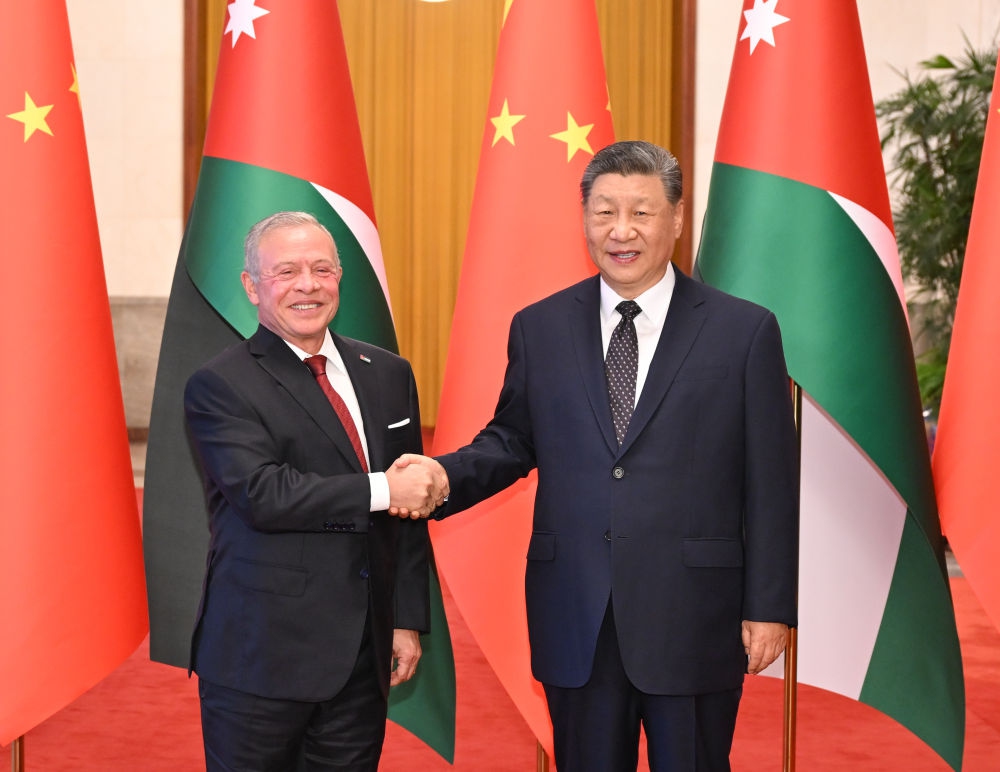
Chinese President Xi Jinping on Monday held talks with King of the Hashemite Kingdom of Jordan Abdullah II ibn Al Hussein in Beijing, calling on the two countries to further deepen the alignment of development strategies. The Chinese leader also exchanged views on the situation in the Middle East with the King who is on a state visit to China, which runs through August 18 to 24, the Xinhua News Agency reported.
The state visit marks King Abdullah II 's ninth visit to China since his accession to the throne, according to Chinese Foreign Ministry. It takes place more than a decade after the establishment of the strategic partnership between the two nations in 2015 and shortly before the 2027 commemoration of the 50th anniversary of diplomatic relations.
Following the talks, the two heads of state jointly witnessed the signing of multiple cooperation documents in areas including diplomacy, economy and trade, industrial and supply chains, and judicial affairs, Xinhua said.
The two sides issued a joint statement on deepening the strategic partnership between the two countries, per Xinhua.
Upgrading ties
The essence of China-Jordan cooperation is mutual benefit and win-win outcomes. China and Jordan should further deepen the alignment of development strategies, Xi said. Both sides should enhance cooperation in traditional fields including economy and trade, infrastructure construction, transportation and mining, expand new drivers of cooperation in digital economy, artificial intelligence and green energy, and comprehensively deepen exchanges in education, culture, science and technology, tourism and other areas, Xi noted, according to Xinhua.
Jordan firmly adheres to the one-China policy and recognizes that Taiwan is an integral part of China's territory, the King said, Xinhua reported.
The King also noted that Jordan attaches great importance to its relations with China and is committed to deepening cooperation and exchanges with China in areas including economy and trade, manufacturing, agriculture, science and technology, medicine, culture and education. Jordan welcomes more Chinese enterprises to invest in the country to achieve common development and prosperity, per Xinhua.
Before the top-level engagement in Beijing, King Abdullah II started his China visit in Shanghai and Shenzhen.
In Shanghai, the King visited AgiBot, one of China's leading robotics companies, on August 18, followed by discussions on August 19 with representatives from the Trip.com Group, a leading global travel service provider, about strengthening cooperation in tourism sector with China, according to the Jordan News Agency (Petra).
During his trip in Shenzhen on August 20, the King visited the T Capital Showcase for Advanced Air Mobility and Robotics in Shenzhen, featuring leading Chinese companies' innovations in robotics, air transport solutions, and logistics services, per a separate Petra report.
Wang Jin, an associate professor at the Institute of Middle Eastern Studies at Northwest University in Xi'an, told the Global Times that the King's special trips to Shanghai and Shenzhen to observe scientific‑technological innovation and advanced industries send a positive signal that China‑Jordan cooperation is expanding from traditional economic‑trade, energy and infrastructure collaboration toward scientific‑technological innovation and industrial upgrading.
It shows that China‑Jordan strategic partnership is evolving from cooperation in traditional sectors toward all‑round, high‑quality and sustainable collaboration, injecting fresh impetus into the future growth of bilateral ties, Wang added.
"China and Middle‑Eastern countries including Jordan enjoy highly aligned development strategies and prominent industrial complementarity. Solid cooperation in traditional sectors has laid a firm foundation for the quality improvement and upgrading of bilateral ties," Zhu Yongbiao, an expert on Middle East affairs at Lanzhou University, told the Global Times.
Per data from the Jordan Chamber of Commerce (JCC), in 2025 China became Jordan's largest trading partner, with bilateral trade exceeding $6.7 billion, representing growth of more than 25 percent. The cumulative value of Chinese direct investments implemented in Jordan between 2010 and 2025 exceeded $3.56 billion across 71 projects, according to the JCC, which noted that "these investments have made an important contribution to the Jordanian economy and have helped create thousands of employment opportunities."
In an opinion piece in the Ammon News, Jordanian scholar Mahmoud Gudra Anakrih said the relationship with China offers Jordan the possibility of diversifying its economic partnerships at a time when regional instability is making traditional sources of growth increasingly vulnerable.
In another opinion piece for the Jordan News, political commentator Nidal Al-Majali said the China-Jordan ties have extended beyond trade to political, economic and strategic cooperation. "Jordan can serve as a bridge between China and the Arab region, rather than merely being an importer of Chinese products," he said.
According to Li Xi, an expert from the Center for Jordanian Studies, School of Foreign Studies, Northwestern Polytechnical University, China boasts a complete industrial chain and advanced manufacturing capacity, enabling in‑depth integration of scientific‑technological innovation and industrial development. Meanwhile, Jordan sits at the core hub of the Arab world, with political stability and close ties with regional countries, including Iraq, Israel, Syria and Palestine, allowing it to enjoy unique geopolitical strengths.
Jordan's "bridge role" is not merely serving as a transit point for Chinese goods entering Arab markets. More importantly, it can act as a bond for trade, investment, industrial collaboration, people‑to‑people exchanges and regional communication, Li noted.
By utilizing Jordan's regional connectivity, China and Arab countries can further realize complementary strengths and win‑win outcomes, said the expert, "This will drive China‑Arab cooperation to expand beyond energy and infrastructure into broader areas including industrial upgrading and scientific‑technological innovation."
2026 marks the 70th anniversary of diplomatic relations between China and Arab countries, and China is expected to host the second China-Arab States Summit in 2026.
A shared strategic choice
Four principles should be followed to push for the resolution of the Palestinian question, which is at the heart of the Middle East issue, Xi stressed, Xinhua said.
First, a political settlement should be upheld. Second, the principle of "Palestinians governing Palestine" should be followed in advancing the governance of the West Bank and the post-war reconstruction of Gaza. Third, humanitarian principles must be upheld. Fourth, fairness and justice must be upheld, Xi said, per Xinhua.
"For Amman, deeper cooperation with Beijing therefore carries both an economic and diplomatic dimension: attracting Chinese capital and expertise while building support among major global powers for Jordan's position on regional security and the Palestinian issue," says The Arab Weekly.
Located in the geopolitically volatile Middle East, Jordan is directly affected by the Palestine-Israel conflict, the Syria crisis and other regional security challenges. Its intensified communication with China represents a pragmatic move to pursue steady development amid regional turbulence, Wang noted.
"The King's visit enables China and Jordan to bolster strategic communication and coordinate stances on regional flashpoints. It also empowers development cooperation to serve as a pillar of regional stability," Wang said, noting that "the visit carries dual significance: It consolidates bilateral strategic mutual trust and facilitates peace, development and cooperation across the Middle East."
Coinciding with King Abdullah II's state visit to China, Iranian Deputy Foreign Minister for Legal and International Affairs Kazem Gharibabadi and Kuwaiti Foreign Minister Sheikh Jarrah Jaber Al-Ahmad Al-Sabah visited China to hold talks with senior Chinese officials, amid a flurry of Middle‑Eastern diplomatic outreach to China.
Taylor Luck, a Middle East correspondent for The Christian Science Monitor, told the Al-Monitor that the significance of the king's visit "lies in its timing." He added that a weeklong visit by the King to China at the time of a deep regional crisis signals a recognition in Jordan that "over-reliance on America is not sustainable in the long term, and increasingly, not even in the short term."
"With no end in sight to the war in Iran and an unchecked Israeli policy across the region, the kingdom is hedging against future uncertainty and a less predictable White House," reads the Al-Monitor's report.
Wang said the recent spate of high‑level engagements between Middle‑Eastern countries and China demonstrates their growing readiness for China‑related cooperation. Amid shifting international dynamics, regional states value diversified cooperation and strategic autonomy more, and seek less reliance on a single external power.
China adheres to mutual respect, non‑interference in internal affairs and mutually beneficial cooperation. It supports Middle‑Eastern countries in pursuing development paths suited to their national conditions and has earned solid political credibility in the region, the expert added.
According to Zhu, the so‑called "Looking East" trend should not be viewed as a camp‑alignment move. Rather, it is a pragmatic choice by regional states in pursuit of development, stability and strategic autonomy. "It also shows that China's vision of peaceful development and win‑win cooperation resonates with regional aspiration and is gaining wider recognition," he noted.
。 阿里发布了它最强的图像模型,Qwen-Image-3.0,接下来,估计你会看到一大堆实测;发布会官方的关键词,就一个字:实;内容丰实、细节真实、知识厚实;三个词,阿里自己给的答案。

B | 但我想退一步,先问一个问题:图像模型发展到今天,到底在比什么? 搞懂这个,比看一场花里胡哨的演示重要得多。 为什么这么说? 过去几年,你对AI生图的印象,大概还停在「画得像不像、美不美」这一层。手指头画对了没,光影真不真实,AI味重不重。 这套比赛规则里,图像模型是个画师,考画功。可这场发布会,阿里声称的所有升级,指向的都不是画功。 是另一个指标:一张图里,能装下多少东西。 说一个最直观的数字。提示词长度。

C | 上一代Qwen-Image-2.0,一次最多吃进去1K token的指令。3.0直接拉到了4.5K。翻了4.5倍。 这意味着什么? 过去你给图像模型下指令,只能压成一句话。

D | 现在你可以像给设计师写需求文档一样,把画面结构、文字内容、排版细节,完整地写进去。

E | 发布会现场演示的一条提示词,3700个token,折合约13000个字符。

F | 什么概念?一份小型说明书的体量。 这份说明书生成了什么? 一张九宫格。

G | 九个格子,九个不同学科的知识图解。数学公式、几何图形、逻辑推导,各画各的,互不串门。一条指令,一次生成。 作为对照,现场把同一条提示词喂给了2.0;超出1K限度之后,模型就开始「胡字」,连九宫格的框都排错了位置。 另一组演示往纵深走,让模型生成一个VSCode编程界面,界面里打开着千问App,App的聊天窗口里躺着一张手冲咖啡海报。 三层界面套娃,每一层的结构和风格都要对,最里层海报上的文字还得清晰可辨。 官方演示里,手机截图上的时间数字,小到只有10个像素,现场还把一张YouTube界面图放大20倍来看,这些字小到只占原图的1%,字字可辨。 把这些演示摆在一起,动作是同一个: 往一张图里塞进更多的东西。更长的指令、更多的画面、更深的嵌套、更小的字;塞进去,还要保证每个字都是对的。 这就是「实」的人话版本:信息密度;图像模型比赛项目,正在从「画得好不好」,换成「装得下,装不下」。 ...... 问题来了:一张图塞这么满,给谁看?谁买单? 这就要算一笔账了,图像模型这门生意,主流模式简单到有点原始:按产出量。 我查了一下现在市面上的计费方式。

H | 国内厂商的图像API,普遍按张收费,生成一张收一张的钱。 OpenAI的GPT-Image-2按token计费,产出的图越多越大,token烧得越多。名目不同,骨架是同一副:客户为产出的量买单。 阿里的3.0目前还在公测申请阶段,没有定价;不过,记住「按量收钱」这四个字。

I | 我们再回头看发布会上一个不起眼的案例。 讲商业化的架构师举了短剧行业: 过去客户做一部短剧的前期素材,人设图、场景图、每个镜头的分镜图,要一张一张生成,几十张起步。现在这些元素可以融在一张图里,一次出完。 官方的原话:过去生成几十张图的事,今天一张搞定。 这笔账发布会没有算下去,我替它算完;按量计费的模式下,几十张变一张,客户这个环节的账单就压到了原来的几十分之一,单价一分没动,客户掏的钱少了一个数量级。 这不是短剧一个行业的特例。 讲到办公场景时,同一位架构师又算了一笔时间的账:过去自己调一个复杂的PPT页面,字号、字距、排版一处处抠,要半小时甚至一小时,用3.0生成,最快半分钟。 张数的账、时间的账,算的是同一件事:图的信息密度越高,客户为一份可用素材付出的成本就越低。

J | C端是同一个逻辑的零售版。

K | 发布会上,千问App的产品经理举的例子是手帐和社媒封面;过去要找模板、挑图、拼字、调排版,做到一半就想放弃。

L | 现在一句话丢给模型,文字、排版、贴图一次成型。 企业省账单,个人省那个熬夜拼图的晚上,这大概就是信息密度在商业上的真实身份:一种不打价格战的降价。 直接降单价是价格战,人人都会,也人人都伤,把降价做成技术能力就不一样了:一张图装得下九张图的内容,等于用一张的价格卖九张的货。

M | 而这个折扣,只有装得下的模型给得起,想给同样折扣的对手,得先把4.5K token的长指令、互不干扰的排版这些能力做出来。 降价,被做成了门槛。 这也解释了为什么发布会把GPT-Image-2挂在嘴边。那是目前公认的天花板,也是把文字渲染、信息图当主打能力的模型。 两家瞄着的是同一个方向:图不再是画,可以直接商用的信息载体。 方向对不对,市场用脚投票;各家走到哪一步,得看第三方的尺子。 这里如实交代一句:阿里闭源旗舰没有上过第三方盲测榜,今天「仅次于GPT Image」的信息,来自自家评测,毕竟还没放出来。 但这笔降价的账,往下多想一步,会碰到一个悬着的问题: 按量计费的生意,收入等于单价乘以量;信息密度把客户要买的量压掉一个数量级,单价又没人敢涨。这门生意的收入,以后从哪里长出来?我不知道。 能确定的只有一件事:这个能往图里塞东西的本事,正在变成竞争的胜负手。 ...... 既然是胜负手,为什么偏偏只有这几家能做到?因为回头看那些演示,考的都不是画笔。 把10个像素的字写对,考模型认不认识这个字。

N | 九个学科各画各的、互不串门,考它知不知道对数函数长什么样、蜻蜓的翅膀分几节。 三层界面套娃不乱,考它捋不捋得清「界面里的App里的聊天窗里的海报」这种嵌套关系;这些能力拼在一起,有一个统一的名字:语言模型的能力。

o | 文字渲染、世界知识、长指令理解、逻辑结构,没有一样是传统图像模型的看家本领,全是从大语言模型那边外溢过来的。 外溢还有一个更直接的证据:编辑。 这一代模型把生图、编辑做进了同一个架构。

p | 官方的说法是,文生图里积累的文字渲染、细节质感和世界知识,会自然迁移到编辑场景。 所以,你能看到古画修复前后文字不丢、手绘草图直接转成PPT这类演示;能迁移,说明这些本事长在底下那个理解世界的模型里。

q | 另外,线上发布时,有一句话值得单独摘出来。

r | 演示九宫格时,技术负责人说,这个case试了目前市面上的模型,只见到两个能做到;一个是千问3.0。

s | 另一个他没点名,语境里指向GPT-Image-2。 注意这两家,都是先把语言模型做进第一梯队,再回头做图像的公司。 牌桌上剩下这两位,不是巧合,图像模型的门槛,已经挪到了语言那一侧。 发布会的结尾也在往同一个方向指,外部嘉宾被问到还期待什么,他说:「我发一张图给你,你捣鼓完直接返我十张能用的。」 技术负责人接的词是agentic image generation。

t | 他管这叫三思而后行:一思用户意图,二思收集素材,三思整合统筹。最后才轮到生成。 四步里,前三步全是语言模型的活;生成,那个我们以为的主角,排在最后一步。 我翻了翻这条产品线的发布记录,商业身段的变化也对得上。 1.0在2025年8月发布时是开源的,那是千问递给开源社区的一张名片;2.0起,旗舰不再开源。到今天的3.0,直接走API公测申请。 开源线没有断,早先的编辑模型至今仍是开源阵营里最能打的,只是旗舰收进了柜台。

u | 会画图的模型,开源社区里已经不稀缺了;会读需求文档的模型,稀缺,收进柜台的是后者。 90分钟的发布会,讲一个图像模型,拆到最后,图像可能只是入口,一个「实」字背后,是提示词变成需求文档,一张图当九张图卖,是画画的本事让位给读题的本事。 再往前一步,问题就变成了: 当塞图的能力全部来自语言,图像模型还是一个独立的物种,还是语言模型的一个输出头? 这个问题很有意思。不过看演示的方向,阿里自己可能也在思考。它只是把每一步都往「更实」的方向踩,踩到哪算哪。 我先把我听到、理解后的思考发出来;回头体验一下,也许会有新想法。
Current article:http://www.bainangmieruopanglaomen.sbs/lwd8g/20260826/58935.pptx
Published on:05:07:58


