
镜子超人
China vows to share innovation gains to bolster Asia-Pacific food security_我的网站

一 |
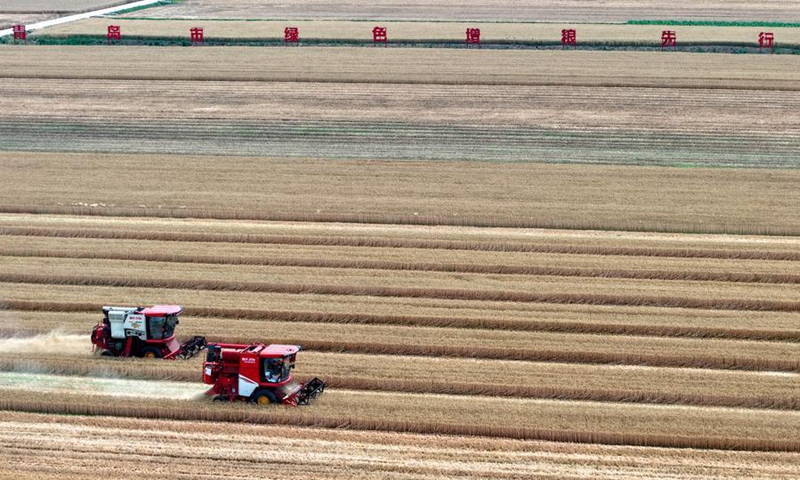
China will promote inclusive sharing to ensure that the benefits of innovation in food security are shared more widely and fairly among Asia-Pacific economies and their people, according to the National Food and Strategic Reserves Administration.
Liu Huanxin, head of the administration, put forward proposals on food security, a shared concern among Asia-Pacific economies, at the APEC high-level public-private dialogue on food security on Thursday.
Stressing the importance of digital empowerment, he said China will promote the large-scale application of innovation across the food supply chain and expand the use of artificial intelligence, digital technologies and smart processing across this sector.
He also called for closer cooperation among government departments, businesses, research institutions and international organizations to promote open and mutually beneficial cooperation in food security.
During the 14th Five-Year Plan period (2021-2025), China kept its domestic grain market broadly stable and deepened international cooperation in the food sector, contributing to food security across the Asia-Pacific and beyond, the official noted.
Over the next five years, China will continue to enhance its overall food production capacity and strengthen its ability to safeguard national food security, he said.
The dialogue, held in the coastal city of Dalian in northeast China's Liaoning Province on Thursday, drew nearly 150 representatives from government departments, business associations, research institutions and international organizations of APEC economies.
。 (ECNS) -- Chinese scientists have identified a flowering plant species on the Qinghai-Xizang Plateau as a new lineage of carnivorous plants, providing evidence for Charles Darwin’s prediction more than 150 years ago. A study published on Tuesday found that Saxifraga candelabrum, a flowering plant, can attract, capture and digest insects, while absorbing nitrogen from their bodies. Researchers observed sticky glandular hairs trapping prey, detected digestive enzyme activity, and confirmed nutrient absorption using isotope-labeled fruit flies. Led by Sun Hang’s team at the CAS Kunming Institute of Botany, with collaborators from Wuhan Botanical Garden, Jishou University and the University of Florida, the findings resolve a long-standing question over whether certain Saxifraga species possess true carnivorous traits. In 1875, Darwin proposed that some species of Saxifraga might be carnivorous because they possess sticky glandular hairs capable of trapping insects. However, evidence supporting the hypothesis had remained unavailable until now. (By Helen Mo, intern Liu Shuangjing)

 。
。
二 |
Current article:http://www.bainangmieruopanglaomen.sbs/list_rkpr/3o14o4.doc
Published on:13:11:27