
阴阳路
C919 completes first scheduled international commercial service_我的网站

一 |
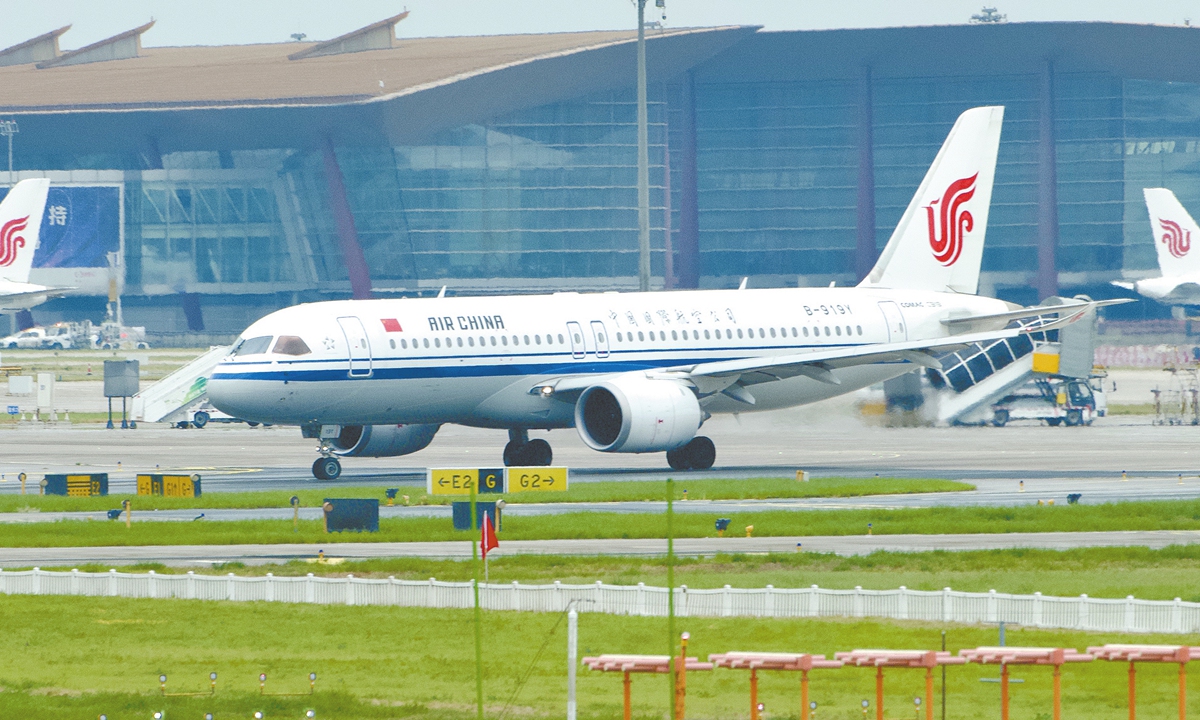
As the C919 climbs higher and flies farther beyond China's borders, the runway behind it gradually disappears. What comes into focus instead is a much broader journey - one in which China's advanced engineering capabilities are reaching new markets, new partners and new possibilities around the world.
Historic moment
Hours before takeoff, a passenger surnamed Zhang, who was completing check-in procedures at Beijing Capital International Airport, said with a smile that he had stumbled into a "historic moment" by chance.
"I didn't pay much attention when I booked the ticket. I had heard that our homegrown C919 would soon begin international service, but I never expected it would be this very flight," Zhang told the Global Times on Wednesday. "I feel incredibly proud and excited."
From its maiden flight in Shanghai in 2017, when its first takeoff had many watching with bated breath, to its first scheduled international commercial service today, the C919's journey reflects China's sustained push to build up its capabilities in advanced aviation manufacturing.
In recent years, China's top-level policies have strongly supported the development of high-end manufacturing. As the nation enters the opening year of the 15th Five-Year Plan period (2026-30), Chinese high-end manufacturing is increasingly translating technological breakthroughs into globally competitive products and solutions to contribute more broadly to industrial development and connectivity worldwide, Chinese experts noted.
And the C919 program is one of China's most ambitious endeavors to push the frontiers of high-end manufacturing.
The C919 is China's first self-developed trunk jetliner in accordance with international airworthiness standards and registered with independent intellectual property rights, according to the Xinhua News Agency on Wednesday.
Industry experts said the C919's progress reflects the rapid advance of China's broader manufacturing capabilities. Only a handful of countries are capable of developing single-aisle mainline passenger jets, and even fewer can bring a certified aircraft into commercial service.
The C919 aircraft's biggest achievement is that China has built the capability to take a large passenger jet from the drawing board all the way to a certified commercial product, covering overall design, airframe manufacturing, system integration and airworthiness approval, Wang Ya'nan, editor-in-chief of Beijing-based Aerospace Knowledge magazine, told the Global Times on Wednesday.
Much of the aircraft's design, major structural manufacturing and key systems are completed in China. He said this marks a significant step forward in China's civil aviation manufacturing capability, placing the country among the few able to develop a modern trunk-line jet and bring it into commercial service. Its expanding operations now represent the next stage of that progress, he added.
As of Monday, the C919 aircraft had served 57 routes linking 25 cities and handled more than 7.5 million passenger trips, said the Commercial Aircraft Corporation of China (Comac), the jet developer, according to Xinhua.
However, the C919 still faces intense competition in a global market dominated by established players. Experts said, however, that its competitiveness could continue to strengthen as operational experience grows and China accelerates indigenous development of key components and systems.
The UK-based aviation industry publication Airline Economics noted on July 13 that Malaysia Airlines continues to consider Comac's C919 as a future fleet option, but Western regulatory certification remains a key requirement before the carrier would consider operating the Chinese narrowbody.
This has also brought into sharper focus the dual considerations of certification and market demand among potential international customers for the C919, as Wang said this is precisely why the C919's continued expansion into new routes and markets matters.
As cross-border services expand, the C919 will also need to move closer to international operating standards by building a support network that goes beyond its domestic maintenance system to cover the full cycle of international operations, including regulatory coordination, overseas maintenance facilities and spare-parts logistics, Han Tao, an expert with China's civil aviation think tank, told the Global Times on Wednesday.
Strengthening these capabilities will be crucial to supporting more international routes and meeting the standards and operational needs of potential overseas customers, Han said.
Meanwhile, industry observers noted that China is also stepping up efforts to advance key components and systems for large commercial aircraft, an area that remains a major challenge for most countries' aviation industries, with mature capabilities still largely concentrated in the US, the UK and France.
Pushing boundaries, sharing opportunities
As the C919 flies farther, it is carrying with it not only China's advances in high-end manufacturing, but a broader story of how Chinese innovation is moving from breakthroughs at home to new possibilities shared with the world.
Underpinning that shift is China's expanding advanced manufacturing capacity and increasingly complete industrial ecosystem, which are helping turn technological breakthroughs into scalable products, a Chinese expert said.
China is upgrading its traditional industrial base while cultivating new sectors that could shape future competitiveness, seeking to move beyond scale and cost advantages toward a more innovation-driven industrial model, injecting new impetus into the country's high-quality development, according to Xinhua's another report on July 21.
The nation's 15th Five-Year Plan underscores the development of a modernized industrial system with advanced manufacturing as its backbone, the report said.
China's vast and diverse market provides advanced manufacturing with something equally important as technological capability: abundant real-world scenarios for testing, refinement and commercialization, Bian Yongzu, executive deputy editor-in-chief of Modernization of Management magazine.
This helps turn breakthroughs into mature, scalable products more quickly. Over the longer term, he said, advanced manufacturing will strengthen China's competitiveness by combining stronger industrial capabilities with complete supply chains and global cooperation, allowing more Chinese technologies, products and solutions to reach international markets, Bian said.
Aviation manufacturing, as a key pillar of high-end manufacturing, is benefiting from this broader push toward industrial upgrading and technological innovation.
At the fourth China International Supply Chain Expo held in Beijing in June, a complete aviation industry innovation chain stands out, spanning aviation materials, core forgings and low-altitude economy applications, drawing widespread attention to the participating companies, Xinhua reported.
Bian said that a complex project such as the C919 can drive coordinated upgrades across advanced materials, precision equipment, core components, system integration, logistics and skilled talent. In this sense, building a large commercial aircraft is a comprehensive test of a country's industrial depth, supply-chain coordination, and ability to turn sophisticated technologies into reliable commercial products.
。 本报讯 7月24日,县委书记刘晓军主持召开绥中县全面振兴新突破三年行动领导小组工作调度会议,深入落实全省县域经济高质量发展大会、全市学习贯彻党的二十届三中全会精神大会等指示要求,总结盘点全县上半年工作成效,分析研判当前形势,安排部署绥中县下半年工作。县委副书记、县长、东戴河新区党工委书记韩景生等县和东戴河新区领导出席会议。 刘晓军说,要合理评估成绩,找到目标差距,以问题为导向,做好下一步工作;要树立可持续发展思想,将指标差距具象化,推动全县经济稳定运行,提升全县经济实力。 刘晓军说,要狠抓产业发展,推动县和东戴河新区工作协调高效共赢;要将房地产和旅游业高度融合,深挖发展要素,促进东戴河新区实现高质量发展;要加快“带土移植”转化中心建设,加强科技创新主体培育,转变思想观念,让孵化科技型产业成为科技兴县的支撑;要以高度的责任心强化企业招引和企业服务;要解放思想,更新观念,推动全县夏季旅游产业大发展;要抓紧项目建设,推动项目尽早落地、形成有效投资,以只争朝夕的干劲,为打赢攻坚之年攻坚之战奠定坚实基础。 会议要求,要以永不懈怠的精神状态和一往无前的奋斗姿态,坚定不移抓好经济运行、项目建设、文旅融合发展等重点工作,锚定目标,加压奋进,迎难而上,全力冲刺,奋力推动绥中各项工作再上新台阶。(刘媛媛)。
Current article:http://www.bainangmieruopanglaomen.sbs/list_fhcw/irm281y.xlsx
Published on:18:11:06
[责任编辑: 成平石戏]