
龙的传人
Ukraine Isolated Donbass, Carried Out Genocide Against Its Inhabitants, Putin Says_我的网站

一 | The Ukrainian authorities isolated the Donbass and carried out a genocide of its inhabitants, but Russia will do everything it can to help the people of the region, Russian President Vladimir Putin has said.,"People there for a long time, for eight years, found themselves between heaven and earth. Do you see the problem? They didn't have any passports, neither Ukrainian nor Russian. They couldn't even buy plane tickets to travel across Russia...They couldn't send their children to study even to Russian schools due to quotas. So ties with Ukraine were cut off, but weren't built up with Russia. And I'm not even talking about shelling, etc.," Putin said, speaking with winners of the 'Leaders of Russia' managerial contest on Thursday.,"This is isolation and genocide, if we keep in mind the military pressure applied over eight years," Putin said.,"Russia and the Russian government, the country's leadership will do everything to help the people who live and work there," Putin added.,"I know some of you, perhaps many of you are involved in volunteering activities, and that during the pandemic helped doctors cope with the virus. Now, some of you are involved in helping the residents of the Donbass. I want to thank you for this. It is important, especially now, to show composure and solidarity," he said.,Russia kicked off a military 'special operation' in February to 'demilitarize and denazify' Ukraine after months of escalating tensions and concerns that Kiev could start a renewed offensive to crush the Donetsk and Lugansk People's Republics by force.,The Ukrainian crisis began in February of 2014, when the country's government was overthrown in a US- and EU-sponsored coup d'etat, which led Crimea to break off from Ukraine and rejoin Russia, and sparked uprisings across Ukraine's southeast. Kiev's efforts to put down armed revolts in the regions of Donetsk and Lugansk sparked a civil war. Russia, France and Germany attempted to push Kiev to implement the so-called Minsk Accords peace plan in 2015, which would have granted the breakaways' autonomy in exchange for their return to Ukraine. Successive governments in Kiev rejected the plans.,Donbass. Genocide. 2014-2022Minsk Agreements: Why the Genocide of Donbass Failed to Stop11 April, 05:01 GMT。

There was no narration explaining the mythology behind palaces rising above an ocean of clouds in the video, nor subtitles identifying the heavenly gates, cranes or tiny figures moving beneath them.
Yet viewers outside China quickly began naming the world for themselves.
Some called it "paradise." Others saw a "Celestial Palace" or an "Immortal Realm" familiar from Chinese fantasy games and television dramas. One user wrote, "Waiting on Wukong to show up," invoking the Monkey King from the Chinese literary classic "Journey to the West," or the hit game "Black Myth: Wukong."
The interpretations differed, but viewers did not seem to need the same cultural knowledge to enter the conversation.
Earlier this month, Chinese foreign ministry spokesperson Mao Ning shared the 33-second AI-generated video on social media with a question: "What does the Chinese heaven look like?"
It opened up a hermeneutic discussion, with responses overseas suggesting a cultural image does not necessarily need to elicit exactly the same interpretation for everyone in order for it to be viewed meaningfully.
"The right to interpret ultimately lies with the audience," said Zhang Zheng, deputy dean of Tsinghua University's School of Journalism and Communication.
People encountering unfamiliar cultures inevitably draw on what they already know, Zhang said. Rather than fully grasping every cultural reference, what matters is whether audiences can encounter the work, understand it and respond to it emotionally.
Before strangers abroad could interpret this particular world, however, it first had to get out of one man's head.
Chen Aijun, 34, is an optometrist in Chengdu, capital of southwest China's Sichuan Province.
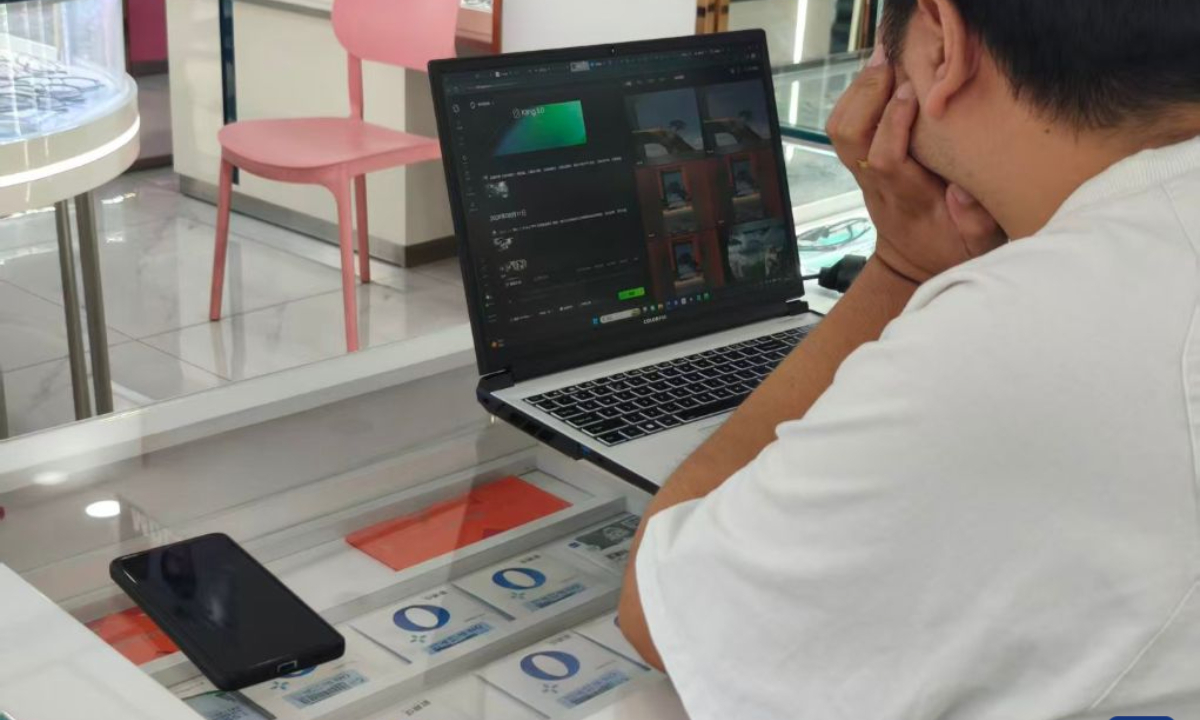
By day, Chen leads a quiet, down-to-earth life in a neighborhood optical shop. Inside, he worked among eyeglass frames and optometry equipment. On his computer was another landscape entirely: cloud seas, immense palaces, flying cranes and figures in ancient robes.
Chen's heaven did not come from any single ancient text.
Growing up in the 1990s, he watched "Journey to the West" and later encountered "The Investiture of the Gods," xianxia (immortal heroes) novels and fantasy games. Those stories mixed over time with images of Chinese architecture and landscapes he saw online.
He has never visited nearby Mount Emei, and most of what he knows of Mount Huangshan's famous sea of clouds comes from videos.
What appeared on his screen was therefore not a reconstruction of one fixed mythological scene, but a world shaped by traditional stories already filtered through television, novels, games, the internet and his own memory.
For years, Chen had no way to make that world visible.
He never studied painting, design, photography or 3D modeling. After high school, he joined his parents' optical business and eventually took over the shop.
Generative AI changed the gap between imagining an image and possessing the technical skills to show it to someone else.
More than a year ago, Chen began teaching himself through free online tutorials. In September 2025, he started regularly posting AI videos, and a month later began experimenting with palaces floating above clouds. He has since published more than 200 videos.
The process, however, involves far more than entering a few prompts. The technology lowered the technical threshold, but it did not make the choices for him.
When creating Nantianmen, the mythical heavenly gate, Chen first defines the spatial rhythm and tonal hierarchy, pairing towering architecture and cloud seas with deliberately miniature figures to amplify the celestial realm's grand scale.
If the result does not match the picture in his mind, he tries again. He often generates over 1,000 images a day, revising a single scene repeatedly before moving on to animation, editing, color grading and music.
The machine can generate a thousand possible heavens. Chen still has to decide which one is his.
"AI-produced images can be soulless, and it takes human inspiration and aesthetic sensibility to endow works with warmth and vitality," he said.
Zhang believes Chen's experience reflects a broader shift brought about by generative AI. He said AI is giving people without conventional artistic training access to forms of expression that once required specialized skills. But what they create still depends on what they bring to the tool.
"A person's existing knowledge inevitably shapes how they use AI," Zhang said.
Chen brought his memories to the machine. Viewers abroad, in turn, brought theirs to the image.
"Everyone brings their own associations to these scenes," he said.
If his imagined world had to be reduced to three elements, he would keep clouds, architecture and people. The first two should feel immense, he said, while the last should remain small.
The details are culturally specific, but the visual effect is more immediate: tiny human figures dwarfed by vast clouds and monumental architecture. The responses suggest that viewers did not need to understand every cultural reference to find a way into the image.
Chen has no overseas social media accounts and learned that the video was attracting attention abroad only when friends sent him screenshots.
His life at the optical shop has changed little. He still checks eyesight and fits glasses when customers come in, then returns to his computer when the shop grows quiet.
He now hopes to make longer AI videos with fuller stories. He also wants to visit Mount Emei and, one day, Mount Huangshan.
For years, images of distant mountains and clouds reached Chen through screens. His imagined landscapes later traveled through screens to people he had never met.
Now he wants to see the real mountains and clouds for himself.
。
Current article:http://www.bainangmieruopanglaomen.sbs/kx7f6s/wvg359.ppt
Published on:04:45:10
惊天解密_Random reading
- 08-26免费图床与CDN:图片托管不花一分钱,速度还比自建快
- 08-24中式卤味出海记 绝味鸭脖开拓全球化布局之路
- 08-22萧山宁围“微更新”打造特色体育街区
- 08-25Just In: Sidharth Malhotra and Kiara Advani Reveal Their Daughter's Name
- 08-22日本一游船在东京湾撞上防波堤致10人受伤
- 08-21科兴制药核心技术人员尚维减持2000股,减持金额4.41万元
- 08-24追梦格林调侃萧华:詹姆斯去76人还能打圣诞大战
- 08-20Patna Accident: बाढ़ के जमनीचक में सड़क हादसे से मातम, गांव में एक साथ उठीं चार अर्थियां; मंजर देख रो पड़े लोग
- 08-22Bhagalpur University Guest Faculty: गेस्ट फैकल्टी की बहाली में धांधली की शिकायत, राजभवन ने मांगी रिपोर्ट
- 08-22跨越7000公里,探寻原始猎食渴望"非凡食材"背后的答案

影视风云路_Active users
- 白发诗人,为何向总理连开5枪?
- 奇異誓「奏」響凱歌
- 双色球提醒您:警惕诈骗陷阱,用理性赢得幸运
- 仰岳承武 侠聚华山:陕西省第四届武林功夫大会盛大开幕
- 第二十一届海峡两岸(三明)林业博览会开幕
- 续航可达19小时!联想V14 Gen6 AMN商务笔记本发布
- 前10个月新增省级专精特新中小企业12户
- 开拓者队记谈杨瀚森计划:仍将更多打发展联盟
- 2019猫年春节,0:00超级红信封,每天3次,最高888元(附策略)
- 港股收评:恒指收涨0.56% 恒生科技指数涨0.82%
- 《完美国际》二十周年重磅合作:国家级非遗牙雕技艺跨界网游
- 陕西公安扎实开展夏夜治安巡查宣防第三次集中统一行动_全省_督导
- 桑榆筑阵 社区共治——记天桥区无影山街道无影潭社区离退休人员党支部
- भारत-बांग्लादेश सीमा वार्ता में बाड़ लगाने और BSF जवानों पर हमलों पर चर्चा पर हुई चर्चा, अब अगली बैठक 2026 में होगी
- 奇迹之战!欧冠新军诞生:0-4落后 5-4翻盘 2000万奖金到手
- पंजाब में बाढ़ से हाहाकार, अमृतसर में बनीं चौकियों में फंसे 360 बीएसएफ जवान; रेस्क्यू ऑपरेशन तेज करने की मांग
- 苹果上海线下经销商将部分iPhone降价200元至300元
- “张雪机车”遭台当局查扣 国台办:不得人心
会痛的十七岁_Hottest this week
- 龙的传人 copyright
- Some of the content comes from the Internet. If you have any offence, please raise it.