
洛神(全文在线阅读)>
洛神300-year-old painting stolen by an American soldier during WWII returned to museum_我的网站
A | 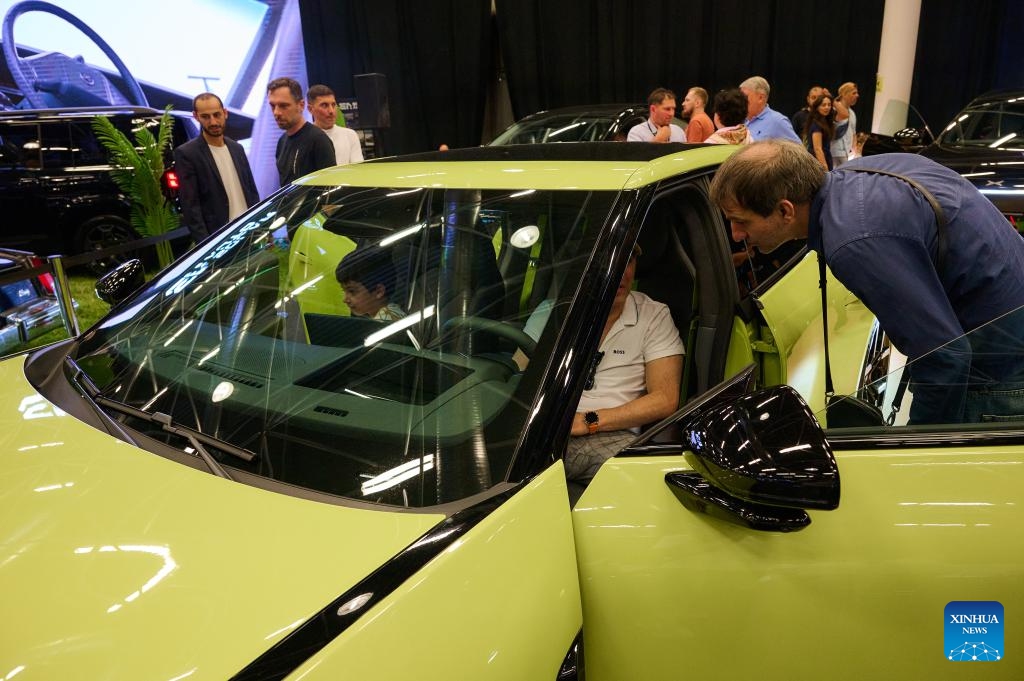 China-made electric vehicles (EVs) accounted for 14.2 percent of European market sales in the first five months of 2026 despite the EU's steep tariffs. The growth showed that trade‑protectionist barriers can only serve as short‑lived obstacles, as consumers' purchasing choice ultimately hinges on product competitiveness and China's EV strengths will support the automakers' long‑term growth, Chinese experts said. The market share of electric cars sold by Chinese companies rose to 14.2 percent in European market in the first five months of this year, according to Schmidt Automotive Research. The 171,800 EVs sold there represented an increase in market share of five percentage points from one year earlier, the Guardian reported on Sunday. The increase in European sales comes despite EU tariffs of up to 35.3 percent for EVs made by some Chinese manufacturers, on top of the standard 10-percent import duty. The UK is the largest European market for Chinese cars because London has declined to follow the EU's lead in imposing more levies. The UK accounted for a quarter of Chinese EV sales in Europe, according to the report. Cui Dongshu, secretary-general of the China Passenger Car Association, told the Global Times on Monday that the surge showed trade protectionist policies have failed to contain Chinese automakers' overseas expansion. Chinese EVs enjoy "a generational edge" over Europe's legacy carmakers. Their overall product strength remains the primary reason behind their popularity among European buyers, Cui said. Meanwhile, fluctuating global oil prices have pushed up driving costs throughout Europe, fueling demand for affordable electric vehicles, a need well‑met by the affordable Chinese‑made models. Meanwhile, the gradual return of European electric‑vehicle purchase subsidies has lowered purchase barriers and lifted total EV sales, which has in turn worked to the advantage of Chinese exporters, Cui Dongshu said. Chinese brands expanded their market share in Europe in the first half of 2026 driven by local subsidies and higher oil prices, Fitch Ratings said in a report sent to the Global Times. The combined market share of leading Chinese brands in the EU, European Free Trade Association and UK rose to 11 percent in the first half of this year, up from 7 percent in the first half of 2025. The largest Chinese players, Geely Group (including Volvo Car) and SAIC Motor, expanded steadily despite the tariffs. The main drivers of market share gains were BYD, Chery and Leap Motor, according to Fitch Ratings. Cui Dongshu noted that China's EV edge comes from its full‑fledged industrial ecosystem. Officials from China's Ministry of Commerce told a press conference on July 28 that China boasts a complete, high‑efficiency EV industrial chain covering raw materials, auto parts, finished cars and production equipment, with industry clusters enabling rapid component supplies. China's huge market, the world's largest, has fueled 11 consecutive years of EV sales. "Protectionism can only put up short‑term entry barriers. It cannot erase the solid strengths of Chinese EVs or stop Chinese brands from establishing a lasting foothold in Europe," Cui Dongshu said. Yet, geopolitical risks remain as the EU reportedly considers expanding tariffs to restrict Chinese plug-in hybrid EVs. German media Handelsblatt reported on June 19 that the EU is drawing up new measures to shield its single market more tightly against Chinese imports in the near future, citing senior EU officials and industry insiders. Specifically, the plan could contain countervailing duties to be levied on Chinese‑made plug‑in hybrids. The rising market share of Chinese‑brand EVs amid EU tariffs has demonstrated that trade barriers cannot distort market choices. If the EU carries out its planned countervailing duties on Chinese plug‑in hybrids, the measure will yield only limited results, Cui Hongjian, a professor at the Academy of Regional and Global Governance at Beijing Foreign Studies University, told the Global Times on Monday. Europe's problems stem from weak competitiveness and flawed energy policies. The EU ought to cast aside its confrontational mindset, remove unfair restrictions and pursue consultations and cooperation with China. Shifting industrial‑sector conflicts outward cannot remedy the weaknesses of its EV sector and will only damage the EU's reputation for destroying free trade, Cui Hongjian said. 。 CHICAGO -- After a stopover in the U.S. that lasted the better part of a century, a baroque landscape painting that went missing during World War II was returned to Germany on Thursday. The FBI handed over the artwork by 18th century Austrian artist Johann Franz Nepomuk Lauterer to a German museum representative in a brief ceremony at the German Consulate in Chicago, where the pastoral piece showing an Italian countryside was on display. Art Recovery International, a company focused on locating and recovering stolen and looted art, tracked down the elusive painting after a person in Chicago reached out last year claiming to possess a “stolen or looted painting” that their uncle brought back to the U.S. after serving in World War II.The painting has been missing since 1945 and was first reported stolen from the Bavarian State Painting Collections in Munich, Germany. It was added to the database of the German Lost Art Foundation in 2012, according to a statement from the art recovery company. “The crux of our work at Art Recovery International is the research and restitution of artworks looted by Nazis and discovered in public or private collections. On occasion, we come across cases, such as this, where allied soldiers may have taken objects home as souvenirs or as trophies of wars," said Christopher Marinello, founder of Art Recovery International. "Being on the winning side doesn’t make it right,” he added.The identity of the Chicago resident who had the painting was not shared. The person initially asked Marinello to be paid for the artwork.“I explained our policy of not paying for stolen artwork and that the request was inappropriate,” Marinello said. “We also know that someone tried to sell the painting in the Chicago art market in 2011 and disappeared when the museum put forth their claim.” But with the help of the FBI Art Crime Team, attorneys, and the museum, Marinello negotiated an unconditional surrender of the artwork.The painting, titled “Landscape of Italian Character,” will now reunite with its counterpart, which shares similar motifs and imagery, according to the museum.The two paintings together form a panoramic scene featuring shepherds and travelers with their goats, cows, donkeys and sheep at a ford in a river. The pair will soon be displayed together for the first time since World War II at the Alte Pinakothek in Munich, according to Bernd Ebert, the museum's chief curator of Dutch and German baroque paintings.Retrieving a long-lost painting "is actually a very rare moment for us,” Ebert said. “It’s exciting.”The Vienna-born artist, Lauterer, lived from 1700 to 1733.When war broke out in 1939, many Bavarian museum collections were evacuated to safe locations in the region, but the Lauterer painting has been missing since the beginning of the war, suggesting the possibility that it had been looted, according to the museum.The Bavarian State Painting Collections first started searching for the painting between 1965 and 1973, but no clues about its location emerged until decades later.Ebert, who flew from Munich to Chicago to retrieve the painting, will carefully bubble-wrap the centuries-old landscape to take it back home, where it will be touched up and restored after an eventful several decades.Luckily, Ebert said, it should fit in his suitcase.___Savage is a corps member for the Associated Press/Report for America Statehouse News Initiative. Report for America is a nonprofit national service program that places journalists in local newsrooms to report on undercovered issues.。
B | Current article:http://www.bainangmieruopanglaomen.sbs/59m7w87/rgxpw4f.xlsx Published on:12:58:57 |

